
Mastering Liver Ultrasound: A Comprehensive Guide for Veterinary Professionals

Updated: Sep 16
The liver is one of the most valuable organs to assess during an abdominal ultrasound. Yet, it’s also one of the easiest to rush through in a busy first-opinion setting. For many GP vets, the challenge isn’t finding the liver; it’s knowing how to evaluate it systematically, interpret subtle changes, and link what they see to meaningful clinical decisions.
This guide is designed specifically for general practitioners who want a clear, repeatable, confidence-building approach to liver scanning. It blends practical technique with structured interpretation and supports vets who want to improve their day-to-day ultrasound skills.
Why the Liver Should Anchor Your Abdominal Scan
Starting your abdominal scan at the liver offers several advantages:
It’s large and easy to locate, even in challenging patients.
It provides orientation for the stomach, gallbladder, diaphragm, and major vessels.
It allows early detection of clinically important findings.
It sets the tone for a systematic, efficient scan.
When GP vets begin with the liver, the rest of the abdomen tends to fall into place more naturally. It becomes easier to maintain a logical sequence, avoid missed structures, and build a consistent scanning habit.

A Simple, Repeatable Framework for Liver Interpretation
A structured approach helps you avoid guesswork and ensures you don’t overlook subtle abnormalities. The following framework is designed for GP practice—fast, intuitive, and clinically meaningful.
1. Size
Assess whether the liver appears normal, enlarged, or small. Useful indicators include:
How far the liver extends beyond the costal arch.
The position of the stomach and pylorus.
The shape of the caudal vena cava.
2. Parenchyma
Evaluate the echogenicity and texture:
Brighter than normal may suggest vacuolar change or steroid exposure.
Darker than normal can indicate inflammation or infiltrative disease.
Mixed echogenicity often reflects nodular change or neoplasia.
3. Margins
Smooth, sharp margins are typical. Rounded edges often accompany hepatomegaly.
4. Fluid
A small amount of free fluid can highlight capsular irregularities. Larger volumes may indicate inflammation, neoplasia, or systemic disease.
5. Biliary System
Assess:
Gallbladder size and wall thickness.
Presence and behaviour of sludge.
Common bile duct diameter.
Any evidence of obstruction.
6. Vascular Landmarks & Other Structures
Portal veins, hepatic veins, the CVC, and any focal lesions should be evaluated in multiple planes. This structured method is easy to teach, easy to document, and ideal for GP vets who want to improve consistency.

A Practical Step-By-Step Liver Scanning Protocol
Step 1 — Begin in the Right Cranial Abdomen
Use the last rib as your starting point. Identify the diaphragm, hepatic veins, and CVC.
Step 2 — Sweep Cranially Under the Costal Arch
Use intercostal windows in deep-chested dogs or when the liver is small.
Step 3 — Locate the Gallbladder
This is your anchor for the right medial and quadrate lobes. Evaluate the wall, contents, and surrounding tissue.
Step 4 — Follow the Portal Veins
Portal veins have bright, echogenic walls and act as a roadmap through the liver.
Step 5 — Assess the Stomach and Pylorus
Their position helps confirm liver size and detect displacement.
Step 6 — Finish with the Left Lobes
These are often overlooked but essential for detecting focal nodules or subtle parenchymal changes.
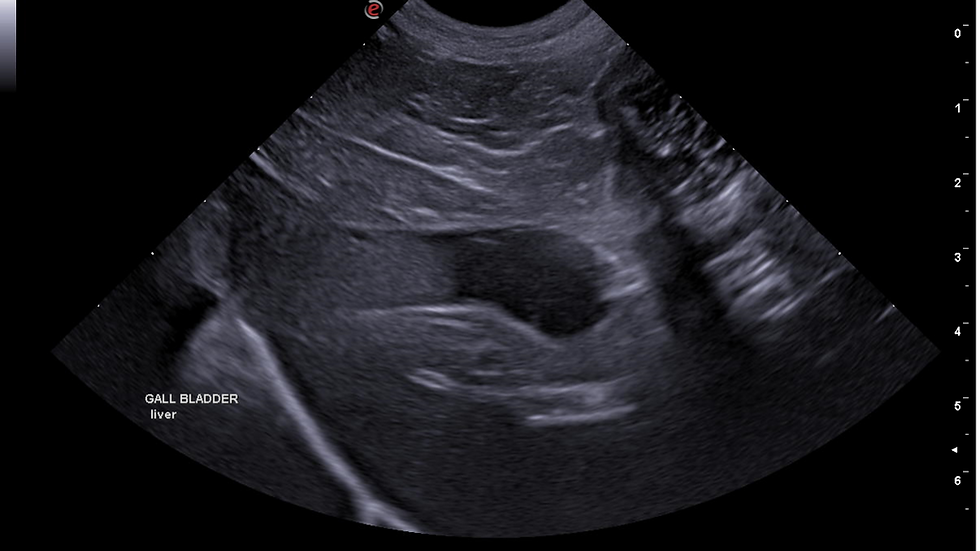
Gallbladder Assessment: Key Points for GP Vets
The gallbladder is frequently misinterpreted in general practice. A few principles help avoid common pitfalls:
Wall thickness varies with feeding — fasting images are clearer.
Sludge is common and often incidental unless immobile or organised.
Early mucoceles may not show the classic “kiwi” pattern.
The common bile duct should be assessed whenever the gallbladder looks abnormal.
A careful gallbladder assessment often provides the first clue to biliary disease.
Common Pitfalls and How to Avoid Them
Falciform fat mimicking a mass — always scan in multiple planes.
Overcalling gallbladder wall thickening — consider feeding status.
Scanning too quickly — small nodules are easy to miss.
Ignoring the diaphragm — subtle hernias can be overlooked.
Not using Doppler — vascular flow patterns add valuable context.
A slower, more deliberate sweep often reveals findings that would otherwise be missed.

When to Consider Referral or Further Support
Referral or additional training is helpful when encountering:
Marked hepatomegaly with hypoechoic parenchyma.
Suspected biliary obstruction.
Complex nodular patterns.
Signs of portal hypertension.
Unclear masses or cystic structures.
If you want to improve your abdominal ultrasound skills, Echo Vet Solutions provides hands-on CPD, in-practice coaching, and structured ultrasound training tailored to GP vets: click here for more info.
Conclusion: Building Confidence in Ultrasound Skills
In conclusion, mastering liver ultrasound is essential for effective veterinary practice. By following a structured approach, you can enhance your skills and improve patient care. Remember, practice makes perfect! Embrace the learning process, and soon you’ll feel more confident in your abilities.
With the right training and support, you can transform your ultrasound skills and provide better care for your patients. Let's embark on this journey together!


